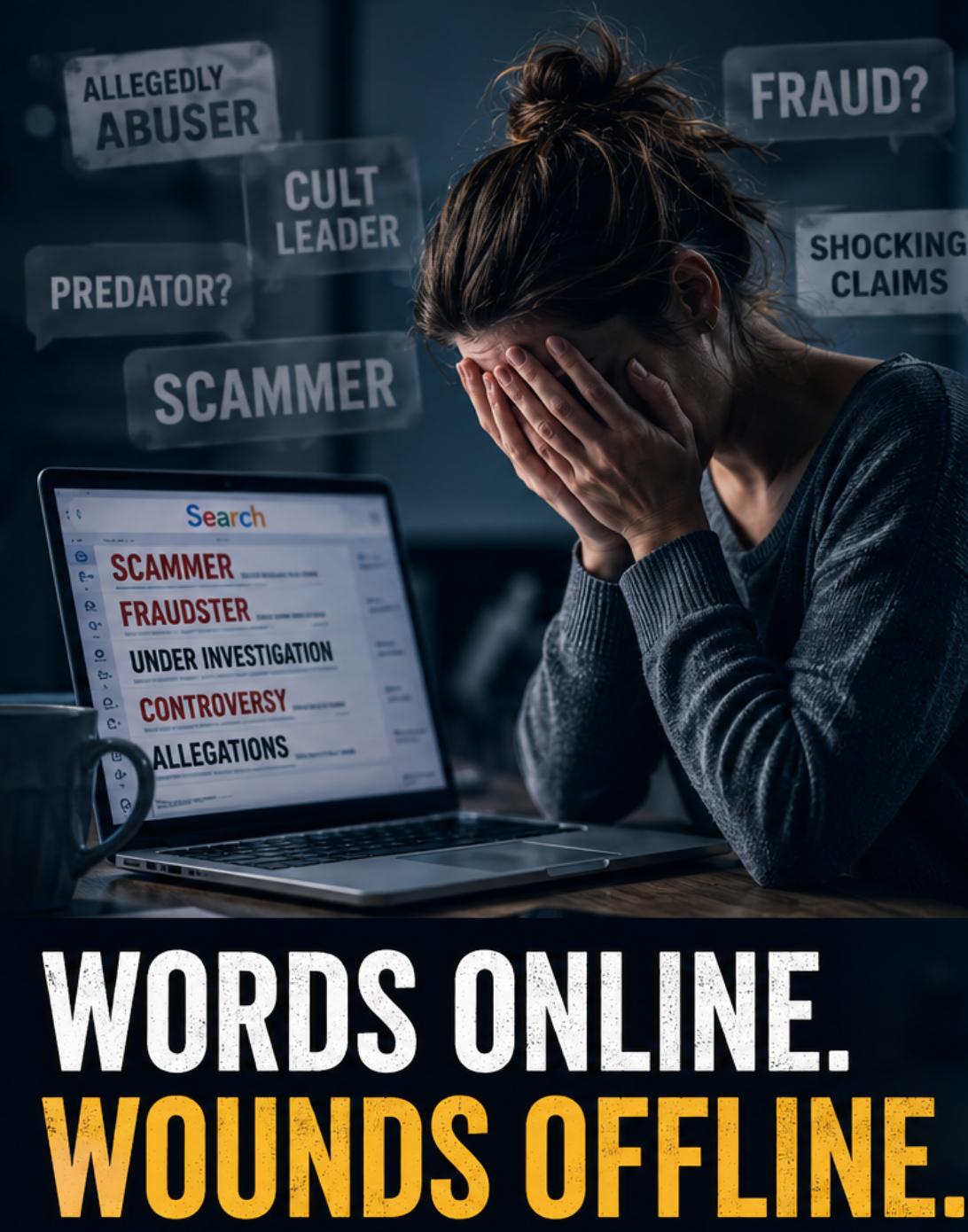
The internet has made accountability easier. It has also made ruining someone easier.
A person can be accused, labelled, mocked, screenshotted, and permanently linked to a claim before anyone has checked whether it’s true. In the old media world, yesterday’s newspaper ended up in the bin. In the search-engine world, yesterday’s accusation can be the first thing a future employer, client, spouse, landlord, or their own children ever finds.
That’s not a small thing.
America rightly protects aggressive speech, criticism, and hard-hitting reporting. The First Amendment gives journalists, commentators, and ordinary people wide room to speak. Public figures face a high bar in defamation cases — they generally have to prove the speaker knew something was false or didn’t care whether it was. See Cornell Law School’s summary of New York Times Co. v. Sullivan.
But being allowed to say something isn’t the same as being right to say it. The Society of Professional Journalists Code of Ethics is clear on this: journalism should be accurate and fair, and journalists should minimise harm. Their code also makes the point that having legal access to information is different from having an ethical reason to publish it — and that journalists should think carefully about what it means to put something online permanently. That principle matters more now than it ever did. Google doesn’t just report a controversy. It preserves it, ranks it, and serves it up again at every significant moment of someone’s life.

The accusation becomes the person
One of the most damaging things online reporting does is weld a person’s name to a label.
Not “questions have been raised about X.” Not “documents suggest X may have.” Not “allegations that remain disputed.”
Just: Scammer. Fraudster. Predator. Criminal. Cult leader. Abuser. Con artist.
Those aren’t neutral descriptions. They’re identity verdicts. Once they’re attached to someone’s name, they tend to stay there — even when the underlying incident is minor, contested, exaggerated, taken out of context, years old, or never actually proven.
In the US, there’s no broad right to be forgotten the way there is in parts of Europe. The First Amendment Encyclopedia notes that American courts don’t recognize a general right to make search engines erase old links just because the information is embarrassing or outdated.

Google does allow removal requests for certain specific categories of sensitive material — see their policy on removing personal information from search results — but that’s a policy exception, not a promise that unfair or stale articles will disappear.
So when someone publishes a sensational accusation, the question shouldn’t simply be: “Can I say this?”
The better question is: “Should this person have to carry this label for the rest of their life?”
The career damage is real
Online reputation affects how people earn a living, and that’s not hypothetical.
The Federal Trade Commission notes that employers can check employment history, education, public records, financial history, and social media activity. If they go through a formal background-check company, the Fair Credit Reporting Act gives applicants certain rights and protections.
But a lot of the real damage happens before any of that. A hiring manager Googles a name. A potential client searches a founder. A school looks up a contractor. A bank spots a public controversy. A business partner quietly moves on. No process, no appeal, no one to explain the difference between an allegation and a fact.
CareerBuilder found that 70% of employers used social media and online searches to screen applicants, and more than half had found something online that made them decide not to hire someone.
A sensational article isn’t just speech. It can function as an unofficial background check — one with no corrections, no context, and no human being on the other end making a judgment call.
Public interest isn’t the same as public punishment
Some reporting genuinely needs to be done. Serious misconduct should be exposed. Fraud should be investigated. People who seek power, money, or public trust should face scrutiny.
But there’s a real moral difference between exposing wrongdoing and turning every human failing into a permanent public record.
A minor mistake isn’t a scandal. An old error isn’t a current threat. A disputed claim isn’t a fact. An allegation isn’t a conviction. A lawsuit isn’t proof of anything. A complaint isn’t a finding. A screenshot isn’t the whole story. A rumour isn’t evidence.
The SPJ Code of Ethics tells journalists to weigh the public’s need for information against the potential for harm, avoid pandering to morbid curiosity, think carefully about publishing personal information, and consider the implications of naming suspects before charges are laid.
Those aren’t rules for people who lack nerve. They’re what separates serious journalism from gossip dressed up as accountability.
Pile-ons have real consequences
Online reputational attacks don’t stay online.
Pew Research found that 41% of American adults had personally experienced online harassment, and that more severe forms had grown from 15% in 2014 to 25% by 2021.
Online reputational attacks don’t stay online.
Pew Research found that 41% of American adults had personally experienced online harassment, and that more severe forms had grown from 15% in 2014 to 25% by 2021.
The psychological risk is particularly serious when an online attack is repetitive, public, humiliating, and impossible to escape. A systematic review of adult cyberstalking and cyberharassment research found that adult victims experienced serious mental-health harms, including depression, anxiety, panic attacks, and suicidal ideation.
That doesn’t mean every harsh article causes a tragedy. Suicide is complicated and should never be reduced to a single cause. The CDC has warned explicitly against oversimplified explanations.
But it is equally dishonest to pretend that public humiliation has no cost.
The adult suicide context matters. The CDC reports that in 2023, an estimated 12.8 million American adults seriously thought about suicide, 3.7 million made a plan, and 1.5 million attempted suicide. More than 49,000 people died by suicide in the United States that year — about one death every 11 minutes. Those figures do not mean online shaming causes every tragedy. They do mean reckless public accusation lands in a country where millions of adults are already carrying severe psychological risk.
US suicide prevention guidance is clear that irresponsible reporting can increase harm. The 988 Suicide & Crisis Lifeline says improper reporting on suicide can contribute to further suicides and recommends against sensational headlines. The American Foundation for Suicide Prevention makes similar points about avoiding graphic or dramatised coverage.

That doesn’t mean every harsh article causes a tragedy. Suicide is complicated and should never be reduced to a single cause. The CDC has warned explicitly against oversimplified explanations.
But it is equally dishonest to pretend that public humiliation has no cost.
US suicide prevention guidance is clear that irresponsible reporting can increase harm. The 988 Suicide & Crisis Lifeline says improper reporting on suicide can contribute to further suicides and recommends against sensational headlines. The American Foundation for Suicide Prevention makes similar points about avoiding graphic or dramatised coverage.
The same instinct should apply more broadly. When writing about someone in crisis, scandal, or reputational freefall, the job isn’t to make the pile-on as entertaining as possible.
“Allegedly” is not a get-out clause
There’s a lazy pattern in online writing: publish someone’s name next to a serious accusation, repeat the ugliest version of the claim, drop in an “allegedly,” and act as though the disclaimer cancels out the damage.
It doesn’t.
Readers remember the accusation, not the caveat. Google indexes the claim, not the nuance buried in paragraph seven. A future employer sees the headline. The subject lives with the consequences — even if the writer technically never stated anything as fact.
Responsible reporting doesn’t just ask, “Can I phrase this in a way that won’t get me sued?”
It asks: Is this true? Is it fair? Is it proportionate? Is it current? Does it need to be published? Is it sourced? Did I include the other side? Have I separated allegation from fact? Am I making this person’s whole identity equal to their worst disputed moment?
Being fair doesn’t make you soft
There’s an odd belief that fairness dilutes criticism. It doesn’t. It makes criticism stronger.
A fair article is harder to dismiss. A sourced article is harder to attack. A proportionate article is harder to paint as harassment. A corrected article is more credible than a stubborn one. Giving someone a right of reply doesn’t weaken the story — it strengthens it.
Good investigative and public-interest writing should be tough. It should ask hard questions. It should expose genuine wrongdoing when the evidence is there. But it shouldn’t casually destroy people, permanently, just because it can.
This matters especially when the subject isn’t a politician, a celebrity, or a powerful institution — but an ordinary person who ended up in public view because of an accusation.
Private people don’t have PR teams, crisis lawyers, media contacts, or audiences ready to hear their side. Once their name is indexed next to something ugly, the burden falls on them to explain themselves forever, to everyone, for the rest of their life.
A better standard
Before publishing anything that could damage someone’s reputation, ask:
- Is the claim backed by reliable evidence?
- Is the headline as careful as the body text?
- Have allegations been clearly separated from proven facts?
- Have old events been put in fair context?
- Has the subject had a genuine chance to respond?
- Is the public-interest value greater than the foreseeable harm?
- Could the same point be made without unnecessary humiliation?
- Are any corrections or updates clearly visible?
- Is this accountability — or is it punishment?
- Would I still publish this if the person harmed themselves tomorrow?
That last one is uncomfortable. It’s supposed to be.
Reputational destruction isn’t abstract. It costs people jobs, relationships, safety, dignity, mental health — and sometimes the will to keep going.
The internet doesn’t forget easily. That’s exactly why writers, journalists, bloggers, and commentators need to remember what the algorithm can’t: the person behind the search result is still a human being.
If you’re in the United States and struggling with thoughts of suicide or self-harm, call or text 988 for the Suicide & Crisis Lifeline.


Leave a Reply